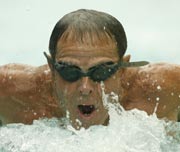
Press, 59, doesn't drink — unless
you count the Diet Pepsi he was nursing at a Detroit cocktail party this month —
or smoke. He's a bit of a loner, close with his family but not many outsiders.
Instead, when he is at the office,
he says he tries to show concern for everyone. His management philosophy is what
he calls the "servant leader," a hands-off approach in which the goal is to help
subordinates as they try to help you.
"I respect the people I work with
to the point my job is to help them understand the vision and direction we all
want to move," Press says, adding that he then tries to "get out of the way."
He's humble, a trait that's both
Japanese and Toyota-like. He frequently stops to chat about basketball with
security guard Bobby Patterson, who has gotten to know Press in the past 18 years.
Press invited Patterson to join him at his courtside seats for a Los Angeles
Lakers game last season. "The Laker girls were right in front of us," Patterson
says.
Press' humility hews closely to
his small-town upbringing. He was born in Pasadena, Calif., but his family moved
to Prairie Village, Kan., when Press was 7. A year later, he built his first
go-cart. As a teen, he discovered the world of motoring, encouraged by an uncle
who sold cars and an older brother who fixed them. In 1959, Press got his first
car, a beat-up 1928 Ford roadster. He was hooked.
"I was in love with cars every
second I can remember," says Press, who once was a mechanic.
After graduating from the state
college in Pittsburg, Kan., Press landed a job as a management trainee for Ford
Motor. When his boss, Max Jamiesson, moved to Toyota in 1970, Press was one of the
two subordinates he brought along.
A good fit
Jamiesson, now a Toyota dealer in
Salinas, Calif., says he knew Press was destined for automotive stardom. He
recalls thinking to himself at the time, "This guy is so good that I will probably
(end up) working for him."
Press didn't plan on sticking
around at the Japanese automaker. He only wanted to stay long enough to learn the
business and become a dealer. Instead, he sensed something different, "the most
special opportunity of a lifetime in the car business" at Toyota.
For 14 years, he lived on a
42-foot power boat docked a few miles from Toyota's headquarters. After marrying,
he raised two of his four kids on board. Along the way, he did stints in the San
Francisco Bay Area, Cincinnati and Japan.
By 1989, Press was ready for
another challenge. He took a job in Florida with Toyota's southeast distributor, a
separate company. There, he worked for a former Chicago TV personality, Jim Moran,
who still admires him. "He was absolutely the best car guy I've ever worked with,"
Moran says. "He was so ambitious and so energetic."
Moran and Jamiesson both credit
Press for his ability to understand Japanese ritual and culture, even if not the
language. "He can charm the Japanese," Moran says.
Jamiesson says Press is a good
listener. He says impressing the Japanese is "a hell of a lot of psychology and
international relations." Press is the first American to serve as president of
Toyota's North American sales operations. Jamiesson thinks eventually he will be
the first American to become part of Toyota's inner circle of elders.
Toyota's top executive in the USA,
Chairman Yukitoshi Funo, thinks Press is a great communicator. But Funo doesn't
see Press as being any better with the Japanese than he is with anyone else.
"He has a special talent to see
things from the perspective of the person he is dealing with," Funo says.
Funo also says that Press has come
to "understand the global agenda of Toyota more clearly."
For his part, Press talks about
Toyota reverentially. "Each of us has a home base in our minds. Some people search
for it and never find it. I found it at Toyota."
He's certainly embraced the
Japanese work ethic. He arrives at Toyota's Torrance campus before dawn and often
doesn't leave until 8 p.m.
"He's here when I get here and
he's here when I leave," says his secretary, Rachel Rivera. In bed by 11 p.m.,
Press thrives on five hours of sleep a night. He often works weekends, too.
Relaxing in the pool
Swimming helps relieve the
pressure of the job and fits in with Toyota's mantra of continuous improvement.
Sometimes, he will go straight to
Toyota's four-lane, 25-meter pool after returning from a trip to Japan. His daily
routine has given him the tanned, upper-body physique of a twentysomething. To see
him walking around in a business suit, you'd never know it: He walks with a slight
stoop. He likes to think it's because of the strong swimming muscles he's
developed in his upper back, but allows it might just be "my own bad posture."
Taking part in master's classes,
he swims competitively and competes in triathlons. The swimming coach at Toyota
headquarters, Rachel Dong, calls him "very committed. ... He is always looking for
ways to improve himself." Plus, he's good about listening to the coach.
Still, his main motivation is
relaxation. Press considers swimming a way "to cool off and put things back in
perspective," says his son Chris, 22, who picked up the swimming bug himself.
When he's not swimming or working,
Press not only hangs out with family but also engages in high-energy activities
such as motorcycling, flying — he has a commercial pilot's license but doesn't own
a plane — and boating. He still has a boat, Eagle, but the family has long since
moved to a landlubber's paradise in Rolling Hills, Calif.
Press never lets up. Daughter
Elizabeth, 16, says even on weekends, "He'll get up early and go work out ... or
go to the beach. He pulls us out of bed."
Naturally, the home has a big
swimming pool.
In the pool, "I will think about
doing strokes. Every time I take a stroke, I think about where my hand is," Press
says.
Each stroke better than the last.