


A bus driver being punched by a passenger is somewhat newsworthy. However, when you have videos of the attack it takes it to a whole new level and becomes the top story of virtually every newscast.
TV stations can do the “If you know the man attacking the driver contact authorities immediately” routine. Raw footage like that makes for great TV (even if the attack happened a week earlier). It is even better because it shows a black man attacking a white driver (although that won’t be mentioned on the air!).
A Kansas City ATA bus driver was attacked by an angry passenger and punched in the face on Oct. 26. KMBC and all the TV stations in town jumped on the story.
Sooner or later the thug will be found and it will give all the media outlets another chance to re-run the footage. It is a media win-win situation.
But what was particularly intriguing about this incident is that it is the second such incident in a week. And the response by the ATA spokesperson seemed to leave a lot to be desired.
“You never want to see these things happen, but with 16 million people boarding the bus every year, these incidents can happen,” said ATA spokeswoman Cindy Baker.
That was a pretty ho-hum response to an assault on one of the ATA’s drivers.
Actually, her response should have directed more toward assuring the ATA’s drivers that they are not risking their lives driving a bus. In other words, she should have spoken more in terms of the employees at ATA rather than “poop happens.”
“We are very concerned about these attacks on our dedicated drivers and will prosecute fully anyone who assaults them,” should have said the spokesperson. “It does not happen frequently, but we have zero tolerance for anyone who assaults one of our employees.”
That response may have given some consolation to one driver who spoke to KMBC:
“A driver who spoke to KMBC 9 News said he’s had to deal with unruly passengers in the past. After hearing about the attack, he said he worries about what could happen every time he pulls up to a stop.”
ATA drivers are scared this can happen to them. The PR message should have been directed at them.



MESSAGE TO THE PUBLIC
John, would you rather have your boss/supervisor communicate to you directly, or through the media and a “spokesperson”?
I am sure that bus drivers go through some fairly extensive training about how to handle unruly passengers, and also have some method, in this day and age, of contacting police for assistance if necessary.
The “spokseperson” should be reassuring THE PUBLIC through the media that bus travel is safe and incidents like this are extremely isolated. You can debate how well this was done in this particular statment, but please, don’t argue against it because it didn’t reassure bus drivers.
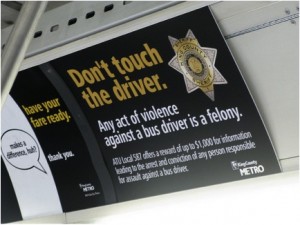
It’s not the public at risk with these assaults. It is the bus drivers, and the public should be given a strong message that this type of occurence will not be tolerated. See photo.
MISSING THE POINT
John, you are missing the point. You said, “The PR message should have been directed at them” — the drivers.
No, the PR message should have been directed at the public. That’s why it’s called PUBLIC relations.
If there are widespread concerns among bus drivers about their safety, then PR messages aren’t going to “address” them.
I would suggest, at the very least, meetings with drivers before or after shifts, soliciting their opinions and their advice about how to solve this, while reassuring them that the perpetrators will be identified and prosecuted — which is why they have security cameras in the first place.
And I have no idea if this is being done, or if it is also a matter of routine that they constantly have such meetings and seek such input.
Until I do, I’m not going to condemn a PR statement for not doing enough to reassure drivers. I don’t know how any PR statement could.
Words are cheap. Action isn’t.
Again, I said that the PUBLIC should be told that attacks on its bus drivers would not be tolerated.
That way you are sending a a message to the PUBLIC and telling YOUR bus drivers you support them.
NO INCENTIVE TO IMPROVE
I ride daily, and a lot of thugs are on these buses. Get on the 106 that stops in the bottoms and scrapes up society’s scraps. The ATA should put up a reward when this happens. Not surprising they don’t. Some buses are dirty and in horrible condition. Some drivers have no social skills and are not very friendly. Try calling the call center for information. They are even worse. If ATA has no respect for their customers, why would they care about their drivers? Take away their federal subsidy and they will go away. As long as they have that subsidy, there is no incentive to improve.
CONFIRMING MAX’S COMMENTS
I ride frequently, including on the 106 bus. I can affirm as correct everything max has said.
WHY GO AFTER A DRIVER?
Was the guy on drugs ? Why would you go after a bus driver, simply doing his or her job ?
If you are that frustrated, go to a boxing gym and duke it out with someone… You may regret it, but at least you would not be on TV or going to jail !!
THANKS FOR STORY
Thanks for following this story, John.
I watched the story and accompanying video (with the requisite “live shot” at the always-exciting bus shelter) and I was shocked at the absolute disregard for the well-being of a colleague on the part of the ATA “spokesperson” not to mention, a total dismissive attitude about public safety. This is “public relations” for a taxpayer supported agency?
As you have pointed out, It would have been better to crank out some templated nonsensical ” We’re concerned, and we’re working with authorities to address an uncommon, yet very real, issue affecting our employees and patrons”..blahblahblah.
At lest, FEIGN concern…
RESPONSE WAS LACKING
Agreed. The ATA response leaves something to be desired. It’s been 46 years since I last rode on a public bus in Kansas City, and I’m not sure I’d be willing to make that same trip through a stretch of the East Side today.