


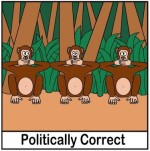
We often tell clients that political correctness trumps everything when dealing with the news media.
Clients may have a wonderful message about their business or group, but if they say or do anything that could be deemed politically incorrect in today’s world they are in trouble.
There are individuals on social media and elsewhere who are ready and more-than-willing to be offended. And the news media loves to seek them out for comment.
One of the more recent examples involved Bruce Levenson, the managing partner of the Atlanta Hawks. He has now apologized and is selling his interest in the team over an email he sent two years ago that contained “racially insensitive remarks.”
According to the Washington Post, part of Levenson’s note said, “My theory is that the black crowd scared away the whites and there are simply not enough affluent black fans to build a significant season ticket base,” Levenson wrote in the e-mail, which also claimed that the Hawks were attracting an “overwhelming black audience” and noted that “there are few fathers and sons at the games.”
Possibly Levenson made his email public with an eye to dumping his ownership in the flailing franchise and cashing in. Either way, once it went public he was soundly beaten into submission.
In the real world his email highlights the kind of marketing decisions virtually every company makes on a regular basis. Who is the target demographic for your business? Are your best customers urban or suburban ones? Wealthy? Health-conscious? What’s are image? How can we grow the business?
Years ago an ad agency was hired to put together a brochure for an inner city health clinic. When it came time to pitch the artwork for the cover a young ad rep suggested using a picture of a black doctor examining a black child.
After all, the writer knew this was a clinic that was hoping to attract a minority demographic, and he “assumed” the audience would respond favorably to a black doctor/child on the cover.
“Uh, that wouldn’t be a good idea,” said one meeting participant. “Our research clearly shows that most blacks would prefer to see a white doctor.”
“What?” said the writer, somewhat incredulously.
“Research has told us the minority community think white doctors are superior to black doctors and they prefer to see a white doctor,” he said, adding, “Use a white doctor on the cover.”
All participants agreed with the decision, including four African-Americans in the meeting. Their goal was to grow the business, not worry about being PC.
While politically incorrect, the decision was made to have a photo of a white doctor examining a black child on the cover of the brochure.
Yes, if the discussion from the meeting ever went public, the outcry would have been monumental and the clinic likely would have been in big trouble.
However, it was a bottom-line decision based on solid marketing research findings.
Was it politically correct? No.
Was it the correct business decision? Yes.




MORE JOURNALISM ‘PEACE’
How about some reference to this ad agency and the aforementioned “story” as far as I’m concerned without a reference source. This is an interesting case study if sourced. Without source’it smacks of ‘opinionated babble. I’d also think the circa of this example you speak would be an important part of understandin your post. I will look forward to reading more journalism’ peace.