|
 |
Posted on Tue, Jun. 15, 2004 |
|
The company: La Superior Food Products Inc., a manufacturer of corn and flour
tortillas, sells its products in a seven-state area. The company offers more than 35
products under its label as well as private labels. Sixty-five percent of its business
is retail and 35 percent is food service.
Telephone: (913) 432-4933
Address: 4307 Merriam Drive, Overland Park, KS
Web site: www.lasuperiorfood.com
Ownership, top management: George Young and Larry O'Brien are co-owners of the
company. Young is chief executive officer and O'Brien is chief operating officer. Other
members of the management team include Darrel Latham, director of marketing; Gordon
Graham, director of operations; and Alex Vilchis, plant manager.
No. of employees: 36
Challenge: Introduce a new product to capitalize on low-carb trend.
Background, research: La Superior was founded in 1979 by Mike Hernandez, who
sold the company to Young and O'Brien in April 2003.
The partners have extensive background in the food industry. Young most recently was
president of Williams Foods Inc., Lenexa. O'Brien was general manager of Spanish Gardens
Food Manufacturing Inc. in Kansas City, Kan., for 25 years.
As the two men took the reins of La Superior, they discovered the company had not
introduced a new product in about 10 years.
“The key to the food business is new products. I began looking around and I saw all
the low-carb products and thought there might be an opportunity,” said Young, who has
been following the Dr. Atkins low-carb diet for two years.
The standard tortilla La Superior produced is 16-17 net carbs. Young set out to
develop a new product – a low-carb tortilla under about 10 net carbs — hoping to capture
a ready market.
Action steps: Young asked four companies to develop a low-carb recipe he and
his management team could sample.
Young said he liked a sample from a Texas ingredient company.
“This one wasn't salty and didn't leave an aftertaste as so many other low-carb
products do,” he said. “A low-carb tortilla is basically a whole wheat tortilla – the
replacement that lowers the carbs is soy.”
With the recipe in hand for a 4 net carb tortilla, Young bought ingredients from the
Texas company and moved quickly to get the product to market in December 2003. Young
didn't want to wait for a new package design, so he placed the low-carb tortilla in
existing bags with a new ingredient label. The package also included a sticker on the
front promoting the new 4 net carbs per serving.
Young went to area grocery stores to pitch the new product and used a network of
distributors to get the product on the market.
Each package of 12 eight-inch, low-carb tortillas retails for $2.09 to $2.25.
While focused on the Kansas City market, La Superior also is selling the item through
a low-carb Web site, which opens it up to customers in Kansas, Missouri and Iowa. The
new tortilla is being sold to area restaurants as well.
Working with Creative Source, a Kansas City company, Young in March designed
new packaging for the low-carb tortilla and other products in the La Superior line.
Results: Young has been pleased with the success of La Superior's new low-carb
tortilla.
”From a sales standpoint, it's been a really good success,” Young said, noting that
it is already the company's third most popular product behind regular 8-inch and 10-inch
flour tortillas.
In January, La Superior sold 500 cases of the new low-carb tortillas. Young projects
the new product will reach about $300,000 in annual sales.
Sales “have stayed pretty consistent,” he said. The low-carb tortilla “makes the
company more profitable and expands the business.” With the success of the low-carb
tortilla, Young is looking to introduce other low-carb products. |
|
Posted on Tue, Apr. 20, 2004 |
|
The company: First Biomedical Inc. rents, sells and services medical infusion
devices used in intravenous therapy treatment. The company's business is split between
rentals, disposable supplies and service work. The company markets a line of
defibrillators, pumps and other equipment used by emergency medical services throughout
the country. It also sells medical tubing, I.V. catheters and dressing change kits.
First Biomedical handles recertification of infusion devices and other general medical
equipment for hospitals that do not have in-house departments to handle such tasks.
Clients include Children's Mercy Hospital in Kansas City and City of Hope
and Cedars-Sinai Health System in California
Telephone: 1-(800) 658-5582
Address: 878 N. Jan-Mar Court, Olathe, Kan.
Web site:
www.firstbiomedical.com
Ownership, top management: First Biomedical is a C corporation. Tom Creal owns
90 percent of the stock and Dan Wassall owns 10 percent. Creal and Wassall manage the
company along with Kirsten Maher and Mike Cain.
Number of employees: 15
Challenge: Create company loyalty and retain employees.
Background, research: Tom Creal started First Biomedical in 1998 after working
for several other companies in the biomedical infusion equipment field. He was
unemployed at the time.
“I had been through what I thought was a parody,” Creal said. “I worked for a (large)
company for 17 years, had been given awards and they had four rounds of layoffs. I was
spared until the fourth one and then I got fired.”
In subsequent jobs, Creal found himself as the last one hired, so when downsizing
took place, he was among the first out the door. Creal said the company showed no
loyalty to the employee. On the flip side, Creal said, it also created an environment
where employees were no longer as loyal to the company. It was a culture he didn't like.
“I thought there was something missing,” Creal said.
After putting a business plan together, Creal secured a Small Business Administration
loan and opened up for business with two employees. Creal, a former Marine helicopter
pilot, was determined to operate his company differently then the way he had been
treated.
“I wanted to develop company loyalty but not be a father figure,” he said.
Action steps: Creal decided the best way to tackle the loyalty issue was to
put together a benefits package for employees that would keep them happy and entice them
to stay. From Day One, First Biomedical provided its employees with dental, life and
health insurance.
“We pay for it for the whole family,” Creal said.
From the time they start with the company, employees have a combination of 15
vacation-sick days to use throughout the year. Employees may carry over unused
vacation-sick days to the next year as well. First Biomedical also opens a simple IRA
for each of its staff with a 3 percent match; employees are vested from the first day
they come to work.
Other benefits include a seven-hour workday, free cell phones for employees who are
on call, free snacks and Costco cards paid for by the company. A new on-site gym greets
First Biomedical employees in the company's new facility. There are plans to begin a
wellness program with a health assessment for all employees.
In keeping with his idea of rewarding employees for performance, Creal said there
would be incentives to take part in the wellness program.
Creating an open and honest atmosphere for employees is another way Creal looked to
create loyalty. Creal is open with employees about the financial situation of First
Biomedical, and he shares the wealth.
“Whenever we have a record gross profit month, employees get 2 percent of their
annual salary,” Creal said. Employees also receive a Christmas bonus of 4 percent to 5
percent of their annual salary.
Employees do not have specific job descriptions either.
“People like the fact they have a job, but because we don't have exact job
descriptions, you can move around,” said Courtney Conant, First Biomedical services
coordinator. “Employees are making contributions we never thought of.”
Results: Putting a variety of benefits into place early on in the company's
life has had a positive impact, Creal said. Only four employees have left the company
since First Biomedical opened its doors in 1998. Creal said the minimal turnover has
helped productivity and revenues.
“We started at zero and we'll be a $3.5 million company this year,” he said.
Employees stay late to finish work and jump in to help in other areas.
“For the most part, I don't think there any employees who hate coming to work,” Creal
said. |
| Posted on Tue, Dec. 16, 2003 |
  |
|
|
|
For small businesses, hurdles — and help
By JOYCE SMITH
The Kansas City Star
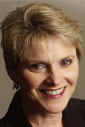 |
| Wheeler |
|
The downturn in the economy presents unique challenges for small
businesses where the focus may change from expanding to surviving, said the
new chairwoman of the Small Business Council of the Greater Kansas
City Chamber of Commerce.
“I am passionately committed to helping small businesses grow and be
successful, and the chamber is so committed,” said Joy Wheeler. “There's
networking, education programs, mentoring, economic forums, international
trade, legislation, the annual Small Business celebrations.”
About 93 percent of the chamber's members are small businesses with less
than 250 employees, and 50 percent of the total membership has less than 10
workers. The council is responsible for the Small Business Celebration
events, serves as a consulting/focus group on small business issues, helps
design the chamber's education and training programs for entrepreneurs, and
sets up discount programs for members.
Wheeler has a bachelor's degree in nursing from the University of
Kansas and a master's degree in public administration with a health-care
concentration from the University of Missouri-Kansas City. In 1996, she was
hired to create FirstGuard, a Kansas City-based health plan that
focuses on Medicaid patients.
She faced significant competition from companies such as Blue Cross
and the former HealthNet, which had strong name recognition and
established credibility. When the company started it had two employees and
faced major national players. Three years later, gross revenues were $68
million, and this year gross revenues are expected to hit $250 million.
FirstGuard now has more than 120 employees and provides services to about
140,000 members in Kansas and Missouri.
Wheeler replaces Sue Mosby for the one-year-term at the chamber. Mosby is
president of the Mosby Group LLC, an Overland Park company that works
with organizations and individuals to help them be more creative and
innovative. She is the new vice chair for small business on the board of
directors of the chamber.
Wheeler said entrepreneurs are so busy running their businesses that they
often don't have time to keep up on issues. The chamber's BizTeam is a
Web-based program that updates members on public policy issues. Business
Brain Food offers educational seminars before work or over the lunch hour.
The chamber also has several events for networking, including its Business
After Hours events, and early next year will offer a Business Before Hours,
a networking session where participants have just a few minutes to talk
about their business.
To reach Joyce Smith, call
(816) 234-7750 or send e-mail to
[email protected]. |
| Posted on Sun, Oct. 26, 2003 |
|
|
|
|
|
HOW I GOT THE JOB: Tim Moore,
Murray Company.
By SUE DYE BABSON
Special to The Star
|
|
| |
|
|
| 'If
you do your work well and with integrity, others will recognize it
and future doors might be opened for you,' said Tim Moore, a project
engineer with Murray Co. - David Pulliam/The Kansas City Star |
|
Tim Moore, 40
Project engineer
Company: Murray Company.
About the company: Murray Co., with offices
in Kansas City and St. Louis, provides design and commercial construction
management services. Murray Co. specializes in managing construction within
the health care, broadcast and commercial real estate industries, but has
completed several warehouse and office space construction projects as well.
My role: My responsibilities consist of
assisting in the bidding process; creating and tracking construction
schedules and submittal schedules; technically reviewing plans, change order
requests, architectural supplemental instruction and requests for
information; and assisting with the subcontract/purchase order process.
Q: How long have you been in this job?
A: Since July.
Q: How long did it take you to find your job?
A: I really wasn't looking. It had crossed
my mind that I might need to start looking for a job, in case I might be
targeted for a layoff at my previous company. But I hadn't even yet updated
my old resume when I was called and asked to provide an interview with
Murray Co.
Q: How did you find your job?
A: The phone call I mentioned came as a
result of a relationship I had had with a previous client. It had been three
years since we had worked together.
Q: Tell me about the interview process.
A: It was less than a week from the first
interview until I knew I had the job. I came in, filled out an application,
had two interviews and went through some personality testing. After
accepting the position, I was in the job two weeks later.
Q: Did you reach a low point?
A: Only insomuch as I wondered whether the
job would be offered. As it was, however, it all happened so fast that there
really wasn't much time for concern to set in.
Q: What is your best advice for others in the
job search?
A: If you do your work well and with
integrity, others will recognize it and future doors might be opened for
you.
Q: What is your educational background?
A: My 22 or 23 years in the construction
business, coupled with college math courses and some classes in interpreting
architectural drawings at Johnson County Community College, has provided my
education. I've been in the construction business all my life.
Q: Is there anything else you would like to
share related to the job search?
A: In the past, what I've done is research
various firms and put together a mailing list for my resume. I think it's a
good idea to target the firms in which you're most interested.
Q: How does this new job fit into your
long-range career plans?
A: I enjoy this line of work and challenges
each day presents. I hope to always either move laterally or upward in each
career move I make. The step to Murray is a move upward due to the expanded
responsibilities and opportunities. I've focused my career around
construction management.
Sue Dye Babson/Special
to The Star
|
Old Westport ENT
& Allergy Inc.
ENT GROUP RECOMMENDS
EAR PROTECTION
FOR FANS AT ARROWHEAD
SUNDAY
For Immediate Release
KANSAS CITY, MO. (October 3,
2003) --- Former Kansas City Chiefs’ linebacker Donnie Edwards said, “It’s so
loud you can see the soundwaves. It’s like the air starts to move.”
The place? None other than Kansas City’s
Arrowhead Stadium, which is one of the loudest places in the NFL, and expected
to be packed to the rafters for Sunday’s key noon matchup between the Chiefs and
Denver Broncos. And, a prestigious audiologists group, says ear protection
should be the order of the day for the nearly 80,000 fans.
In fact, the noise level might reach such
levels that the doctors and audiologists at Old Westport ENT & Allergy at St.
Joseph Health Center in Kansas City are recommending that fans---particularly
youngsters---should wear ear protection if they plan on attending Sunday’s
game.
In the past, sound levels at Arrowhead have
reached approximately 120 decibels---more than 600 times louder than a normal
conversation. That can be compared to a jet taking off, a band concert or
thunder. In comparison, a normal conversation is about 60 dB, and shouting in
an ear about 110 dB.
“I would strongly recommend that all fans
consider some wearing some inexpensive foam plugs that will reduce the level by
about 30 decibels,” says Old Westport Audiologist Kim Carnelia. “At the very
least young children should have ear protection. Most of the players will be
wearing ear protection, so it only makes sense for fans to take the same
precautions.
“We’d like to see fans leave the game relishing
a victory rather than going home with ringing in their ears,” she added.
Founded in
1929, Westport ENT & Allergy Inc. provides audiological, hearing aid services
and repairs. The group is located at St. Joseph Medical Mall, Bldg. B, 1004
Carondelet Dr.,Suite 450, Kansas City, MO 64114.
###
(For information contact: Kim Carnelia at (816)
942-7200; or John Landsberg, Bottom Line Communications (913) 338-5760.)
| Posted on Sun, Aug. 24, 2003 |
|
|
|
|
|
HOW I GOT THE JOB: Tammy Ault,
FirstGuard Health Plan
|
|
| |
|
|
| An Internet
search led Tammy Ault to her job as manager of business system
development with FirstGuard Health Plan. There are many Web sites,
so the key is finding the one that works for you, she said. - Fred
Blocher/The Kansas City Star |
|
Tammy Ault, 31
Manager, business system
development
Company:
FirstGuard Health Plan
About the company: Founded in 1996, FirstGuard
Health Plan is a locally owned health plan providing health insurance
programs to government entities.
My role: I am the manager of a team handling
application design and development, application support, system
configuration, analysis of business requirements and the project management
to support all strategic and business objectives.
Q: How
long have you been in this position?
A: About two months.
Q: How
long did it take you to find your job?
A: I had searched for several months before
finding FirstGuard, but after that the process with FirstGuard happened very
quickly -- within a couple of weeks. FirstGuard did not drag the process out
like some companies. If a company knows what it is looking for and you have
a need, there should not be a reason to prolong the choice.
Q: How
did you find your job?
A: Through an Internet search.
Q: What
worked in the job search?
A: There are so many sites now that you can
search. The key is finding the right one that works for you and your needs
as an individual.
Q: Did
you reach a low point?
A: No. I was one of the fortunate ones in that I
was not unemployed. I am thankful for that.
Q: What
is your best advice for others in the job search?
A: Hang in there. There are jobs out there, but
you have to persevere.
Q: What
is your educational background?
A: I have a bachelor's degree in organizational
communication from Arizona State University (1994) in Tempe and a master's
certificate in project management from George Washington University (2001)
in Washington, D.C. This year I received my certification as a project
management professional.
Q: Tell
about your previous work experience.
A: Professionally, I have only been with three
other companies. Every job has been a steppingstone and helped me grow my
career and knowledge to make me a better person. I have done some great
things and met extraordinary people along the way.
Q: Is
there anything else you would like to share related to the job search?
A: Everything happens for a reason. Do not take
just any job. Instead, find a place to grow in your career and continue
building on your dreams.
Q: How
does this new job fit into your long-range career plans?
A: FirstGuard's culture has given me the
opportunity and flexibility to do what I want to do 100 percent. FirstGuard
is supportive by nature, so I am able to continue in following my dreams of
making a difference. |
The
Kansas City Star
(August 19, 2003)
NEWS RELEASE
HEALTH,
CONVENIENCE
WINDOW TINTING, REMOTE
STARTERS ON INCREASE AS HEAT
WAVE CONTINUES IN KC
For Immediate Release
KANSAS CITY (August 28, 2003) --- As the
temperatures continue to climb above the 100-degree mark daily in Kansas City,
more people are having their car windows tinted and remote starters installed,
according to Jack Rush, who operates Alta Mere window tinting businesses in
Olathe and Lee’s Summit.
Rush says he has seen at least a
25% increase in business in both July and August at his stores. There are a
number of good reasons:
·
Tinted windows reduce harmful UV radiation (that can cause skin
cancer) up to 99 percent. Dermatologists even recommend people wear sunscreen
while driving.
·
People want to start their cars remotely to avoid the “blast
furnace” effect with a car parked outside for several hours.
·
Tinting can reduce heat by up to 50 percent and increase the
efficiency of air conditioning. It takes longer for the car to heat up and less
time to cool down.
·
Tinting reduces ultraviolet rays and heat that can cause interiors
to fade and crack.
·
Many drivers prefer tinted windows to enhance privacy and safety.
“We have definitely seen both the
tinting business and remote starter
business increase dramatically in this weather,” says Rush.
“We aren’t complaining about the heat!”
Alta Mere focuses on window tinting, remote
starters and auto alarms, but is also expanding into audio, video, spoilers and
wheels. The Olathe business is located at 395 North Ridgeview Rd (near I-35 and
Santa Fe). Phone: (913) 768-TINT (8468). The Lee’s Summit location (which
opened July 1) is at 1312 Southwest Market St. (1/4 mile south of Hwy 50, just
west of 291 South).
Contact: Jack Rush (913)
219-7460; or John Landsberg,
Bottom Line Communications,
(913) 338-5760.
Kansas City Star, Tuesday, 6/10/03
|
|
|
Business |
| |
|
Posted on Fri, Feb. 28, 2003 |
|
|
|
|
CITYSCAPE: Advice from a wedding planner: `Eat,
Drink and Get Married'
By JOYCE SMITH
Columnist
A good wedding planner is a mix of Martha Stewart and Dr. Phil, says the
owner of Nolte's Bridal Collection in Overland Park.
Michael Nolte has dealt with heart attacks at wedding receptions,
cancellations that occurred the day of the big event, microbursts that blew
over tents, and people trying to disrupt the ceremony by shouting
obscenities.
While those might be considered crises, Nolte advises his clients to
redefine the term. As a planner of more than 1,000 ceremonies over 23 years,
he's had only one "crisis."
That occurred in a torrential rainstorm when a bride's great-aunt fell
face first onto the marble floor of a church and was severely injured.
"There were all these guests trying to get in the church, out of the
rain, and here was this lady lying there unconscious in the foyer of the
church," Nolte said. "So I'm calling 911, covering up the lady with my
topcoat so she doesn't go into shock. I have all these guests to deal with.
I have these bridesmaids to deal with. I have blood all over the floor and
the bride coming in the limo in 10 minutes."
Nolte had the limousine take a detour without telling the bride there was
an accident, got substitutes for the participants in the bridal party who
had to ride to the hospital, and had the mess cleaned up by the time the
bride arrived.
"A crisis is someone in danger of losing their life, and short of that it
could be a challenge, a frustration, a disappointment," Nolte said. "But
they're still going to get married."
One bride took exception to her father's guest, his girlfriend, because
he was still married to the bride's mother. There was a showdown two days
before the wedding when the father threatened to freeze a credit card
account.
Nolte worked out a compromise. The girlfriend came but was seated on a
side aisle, not with the family.
Another client spent $500,000 for aisles full of violinists and $40
candles, the best linens and ornate flower displays, live music, a $15,000
wedding dress and more.
While the average wedding in the U.S. was $19,600 in 2001, most of
Nolte's clients spend between $40,000 and $50,000.
"You don't want to have chips and salsa on a tray," Nolte said. "So be
sure that the people that you are spending maybe $200 a head to feed, that
these are people you really value. Is that relationship worth $200 of your
hard-earned money to entertain that night?"
This weekend Nolte will offer an alternative to large bridal fairs. "Eat,
Drink and Get Married" will be a more intimate benefit dinner party and
fashion show. It will be held from 5 to 8 p.m. Sunday at the Ritz Charles,
9000 W. 137th St. in Overland Park.
The event is for engaged couples and their parents. Space is limited to
about 200 people. Some reservations are still available.
For $20, guests get a four-course dinner, open bar, dancing, and door
prizes that include a honeymoon cruise. They can visit displays by
photographers, videographers, musicians, florists, caterers, cake designers
and honeymoon planners.
Proceeds go to Alexandra's House, a perinatal hospice in Kansas City. |
|
|
|
Business |
|
|
Posted on Tue, Feb. 25, 2003 |
|
|
|
|
HOW I GOT THE JOB: Donna Hauser, contract
administrator, Murray Co.
By SUE DYE BABSON
Special to The Star
 |
| |
|
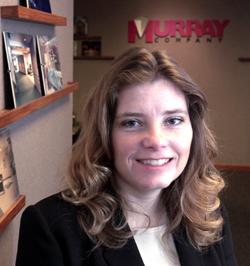
| In a job search, suggests Donna Hauser
of the Murray Co., try going through a temp agency. "Even if you
don't get a permanent offer, you still have an income and are
gaining experience in different fields through your temp
assignments," she said. - Fred Blocher/The Kansas City Star |
|
Donna Hauser, 36
Contract administrator
Company: Murray Co.
About the company: Murray Co. specializes in health care building
design and construction. The company offers design/build, construction
management and general contracting services.
Q: How long have you been in this position?
A: About a month.
Q: How long did it take you to find your job?
A: I wasn't actively looking for a job. I had taken time off to
raise my son. When he started school this year, I decided to work for a
temporary agency to ease back into the work field, but really wasn't
planning something like this....It just happened.
Q: How did you find your job?
A: I started working for Staffing Kansas City in late
October. About a week after I was hired by this temporary agency, I was
asked to do a temp job for the Murray Co. When a position opened up at the
Murray Co., I was asked if I would like to be considered for it. I had some
informal interviews, and then a formal interview with a principal of the
company before I was offered the job. Normally it's a much more complicated
process, but they knew my work already.
Q: What helped finalize your selection for this job?
A: The fact that most of my co-workers already knew that I could
do the job and I have a pretty good work ethic. Having a temporary job there
allowed me a chance to show I was capable of doing a lot of different
things. They saw I was ready to do whatever was needed and could do my job
well.
Q: Did you reach a low point? If so, how did you overcome it?
A: Yes. The company took a while to make a decision. This all
happened over the holidays in late December, and things were complicated by
key people being out of the office. Meanwhile, I had gotten another job
offer after applying for a position I read about when skimming the want ads
in the newspaper. However, that other position would have been in a
"smoking" office, and I really didn't want that environment. Nonetheless,
the fact that I received another offer buoyed my spirits and gave me the
confidence to realize that if the job with the Murray Co. didn't work out,
there would be some other job out there that I was meant to have.
Q: What is your best advice for others in the job search?
A: Try going through a temp agency. If you have the right skills,
they can help you. Even if you don't get a permanent offer, you still have
an income and are gaining experience in different fields through your temp
assignments.
Q: What is your educational background?
A: I have a bachelor's degree in English from the University of
Kansas (1992) and am currently working toward a degree in communication
design at Johnson County Community College.
Q: Is there anything else you would like to share related to the job
search?
A: Figure out what you want in a job before you start. There is no
sense in chasing down a lead if it will ultimately be a bad fit. If you know
what you are looking for, you are in a better position to take advantage of
unexpected opportunities.
Q: How does this new job fit into your long-range career plans?
A: There is a tremendous amount of growth potential in the Murray
Co. After I receive my degree in communication design, that will further
enhance my work in an office environment like this. If I ever need to change
companies later on, I plan to go through a temporary agency again so that I
can get a good feeling about the company environment before I start. I
walked into this with my eyes open.
Sue Dye Babson/Special to The Star
|
Kansas City Star, The (MO)
Section: CITY
Edition: METROPOLITAN
Page: 9
Column: NEIGHBOR PROFILE
FirstGuard Health Plan has
grown with focus on ethics Company president has led employees to three
awards
FRANKLIN AWORI
The Kansas City Star
Joy Wheeler
exchanged pleasantries with an employee, hugged another she hadn't seen for
a while and engaged in an animated conversation with a nurse about her work. |
|
All within a
few minutes.
But knowing - and acknowledging - all of the 100 employees at FirstGuard
Health Plan is important to Wheeler.
She is the president of FirstGuard Health Plan, a Kansas City health care
management company that received the 2001 Kansas City Business Ethics Award.
FirstGuard also was twice voted - in 2000 and 2001 - in the list of Top
Ten Small Businesses of the Year by the Greater Kansas City Chamber of
Commerce. For FirstGuard, business ethics was an issue before companies started
tumbling from reports of accounting irregularities.
"We have always viewed business and ethics as inseparable," Wheeler
said. "This is even more important in the health-care business where, more
often, people's lives are at stake.
"Integrity, respect, teamwork and excellence have always been the
cornerstone of our values even as we continued to expand."
FirstGuard was formed in 1996 in response to plans by the state of
Missouri to privatize Medicaid. Wheeler, who was then a health-care consultant, was given the task
to start the company and ensure it met conditions set by the state
government. FirstGuard is a subsidiary of Model Cities Health Corp. of
Kansas City.
It had start-up capital of $5.5 million. Six years into operation, the
company has $225 million in annual revenue. Its work force had grown from 20
to 100, and the number of clients has grown to about 140,000 people, up from
26,000 in 1997. About 5,000 physicians are contracted to the company.
To win the ethics award, FirstGuard competed against 34 other firms. The
award is administered by the Society of Financial Services, a 74-year-old
organization with about 28,000 members and 200 chapters nationwide.
Among the things the award committee looks for is a corporate code of
ethics or a philosophy that clearly communicates a company's requirement for
honesty, integrity and compliance with the law.
"FirstGuard exemplifies good business ethics in the entire organizational
structure," said Donna Owens, co-chair of the annual award committee. "The
company's mission of doing what is good for the customer was key to its
winning the award."
The award committee noted that implementing a vision for an organization
can be difficult. "But Wheeler has proven that it can be done
successfully, ethically and to the benefit of everyone involved," the
committee said.
Wheeler thinks all people have the ability to act responsibly and
said any company that expects employees to act ethically must clearly draw
the line of acceptable behavior.
"Any company that cherishes ethics and growth must hold its employees
accountable for their behavior and activities," she said.
Wheeler said she is concerned that businesses have adopted a short
view to success. She sees this as the major cause of ethical lapses in the
corporate world.
"As businesses, we have rewarded ourselves based on quarterly results,
and the outcome has been serious erosion in public confidence," she said.
At FirstGuard, all employees take financial literacy training to
understand company financial information and how it relates to their jobs.
Wheeler said a company that expects to motivate employees must
recognize and reward those doing the right thing. FirstGuard yearly awards
excellent employees.
Wheeler credits the company's fast growth to employees'
commitment. "The employees have been able to professionally respond to new business
demand and still maintain the culture of care and compassion," she said.
Employees said Wheeler's strong leadership has been important in
guiding the company.
"Wheeler is a very responsible president who motivates employees.
Her open door policy has made every employee feel part of the company," said
Melinda Armstead, a nurse at FirstGuard.
Armstead is a member of the company's "Ambassador" team, a seven-person
team that developed the company's credo. Employees keep the credo on their
desks to remind them of their responsibilities and mission. The team also
coordinates various community activities. Its members are elected every two
years.
Wheeler is also involved in several community programs, but she
said she encourages employees "to strike a balance between family and work."
She has a 9-year-old son, and she plays tennis and golf and gardens.
"I work normal office hours and I try to make sure all employees do the
same," she said.
Wheeler said she derives her ethics from her nursing background;
she worked eight years at Liberty Hospital as an emergency room nurse. She
held managerial positions in Cigna Health Care from 1985 to 1993 and later
became a senior health care consultant with Towers Perrin Integrated
Healthsystems Consulting.
Wheeler graduated with a bachelor of science degree in nursing
from the University of Kansas in 1977 and a master's degree in public
administration, health services, from the University of Missouri-Kansas City
in 1984.
"My prime responsibility as a nurse was to help people, and I think the
same still applies to my work in the health-care management business," she
said.
"I still see myself working in trauma center where time is an essence in
saving life. People come here with health needs, and it's our responsibility
to satisfactorily address those needs."
|
"Integrity, respect, teamwork
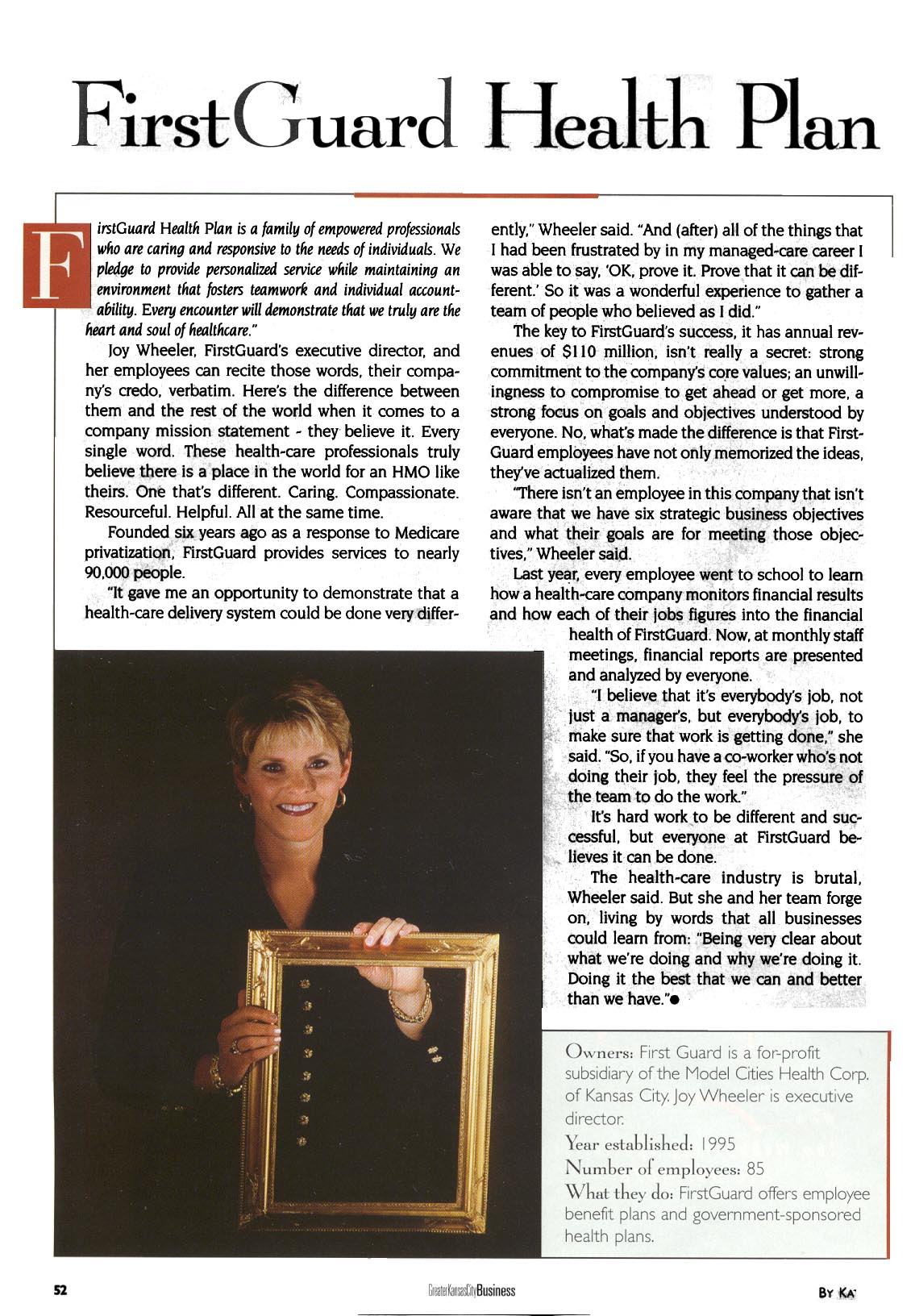
and excellence have always been the cornerstone of our values ," said Joy Wheeler, president of FirstGuard Health Plan. |
| |
|