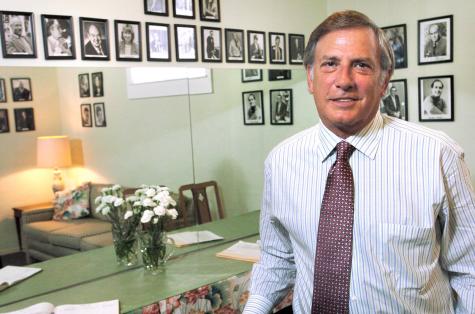
The anchorman whose boss once characterized him as
ice compared with his successor's fire was anything but chilly in the
impassioned speech he delivered Tuesday at The Society of the Four Arts.
"Truth no longer matters in the context of politics
and, sadly, in the context of cable news," said Aaron Brown, whose four-year
period as anchor of CNN's NewsNight ended in November, when network
executives gave his job to Anderson Cooper in a bid to push the show's ratings
closer to front-runner Fox News.
Brown said he tried to give viewers a balanced diet
of light and serious news with NewsNight. "But I always knew when I got
to the Brussels sprouts, I was on thin ice," he said.
When NewsNight spent four hours covering the
arrest of actor Robert Blake for the murder of his wife, Brown received
thousands of e-mails criticizing the amount of time the show spent on the story.
Nevertheless, that show, which aired in April 2002, received the highest ratings
of any program since NewsNight's coverage of the November 2001 crash of
American Airlines flight 587.
"Television is the most perfect democracy," Brown
said. "You sit there with your remote control and vote." The remotes click to
another channel when serious news airs, but when the media covers the scandals
surrounding Laci Peterson, the Runaway Bride or Michael Jackson, "there are no
clicks then," the journalist said.
With the departure from the screen of the "titans" —
Tom Brokaw, Peter Jennings and Dan Rather — who "resisted the temptations of
their bosses to go for the ratings grab, it will be years before an anchorman or
anchorwoman will have the clout to fight these battles," he said.
Brown has spent most of his 30-year career in
television news. He's covered everything from the Columbine High School murders
to the aftermath of the space shuttle Columbia disaster. But viewers may
remember best his on-the-spot coverage of the terrorist attack on the World
Trade Center.
He's shocked "by how unkind our world has become,"
he said. E-mail and talk radio appear to have given people the license to say
anything, regardless of how cruel or false it may be, he said.
He cited the example of an e-mail faulting what the
sender considered to be NewsNight's inadequate coverage of an anti-war
protest in Washington, D.C. The note ended with, "I hope the violence visited on
the people of Iraq will someday be visited on your children."
Those on the opposite side of the political spectrum
are no more tolerant, Brown said. "Any criticism of the administration is
regarded as hatred of the president and hatred of the country itself," he said.
Important issues, such as the prosecution of the war
in Iraq at home and abroad, are being clouded over by "mud-wrestling" that
skirts substance, he said. Consider what he called "the swift-boating of John
Murtha," the Democratic congressman whose war record was smeared when he called
for an exit strategy in Iraq. "Cable didn't search for the truth, but engaged in
mock debates pitting those making the charges against Murtha's defenders," he
said.
Many Americans on the left and the right aren't
interested in the truth, but simply want news that confirms their viewpoints, he
said. "You'd think that it's no more complex than good vs. evil," he said.
Journalists have fallen short in presenting
important news in ways that allow viewers to see how it matters in their lives.
But viewers must take up the battle as well, he said. "It's not enough to say
you want serious news. You have to watch it. It isn't enough to say you want
serious debate. You have to engage in it."