|
Do you
know the difference between advertising and public relations? It can get
confusing, but here are 10
differences. In a nutshell, this says it all:
"Advertising you pay for. PR you pray for!"
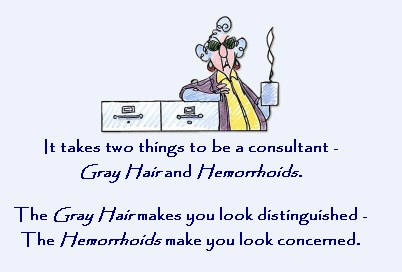
MAXINE'S VIEW OF
CONSULTANTS
|
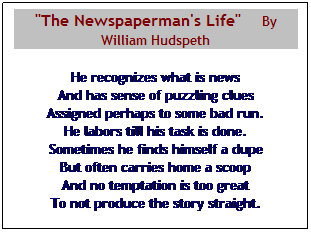
"The Newspaperman's Life" By
William Hudspeth
He recognizes what is news
And has sense of puzzling clues
Assigned perhaps to some bad run.
He labors till his task is done.
Sometimes he finds himself a dupe
But often carries home a scoop
And no temptation is too great
To not produce the story straight.
|
We developed our tongue-in-cheek
"16 Sure-Fire Ways to Impress the Media"
poster years ago. It has been quoted in publications all over
the country and in a fun way gets the point across that you should know how to
work with the media if you want your business to get positive coverage.
How the media would handle the end of the
world
USA Today: WE'RE
DEAD.
Wall Street Journal: Dow Jones Plummets as
World Ends.
National Enquirer: O.J. and Nicole, Together
Again.
Inc. Magazine: 10 Ways You Can Profit From the
Apocalypse.
Rolling Stone: The Grateful Dead Reunion Tour.
Sports Illustrated: Game Over.
Playboy: Girls of the Apocalypse.
Lady's Home Journal: Lose 10 Lbs by Judgment
Day with Our New "Armageddon" Diet!
TV Guide: Death and Damnation: Nielsen Ratings
Soar!
Discover Magazine: How will the extinction of
all life as we know it affect the way we view the cosmos?
Microsoft Systems Journal: Netscape Loses
Market Share.
Microsoft's Web Site: If you don't experience
the rapture, DOWNLOAD software patch RAPT777.EXE.
America OnLine: System temporarily down. Try
calling back in 15 minutes.
"The biggest difference between Kennedy and
Nixon, as far as the press is concerned, is simply this: Jack Kennedy really
liked newspaper people and he really enjoyed sparring with journalists."
----Ben Bradlee

Over the years, the supposed
wall between advertising and editorial has been slowly chipping away to the
point that sometimes the average reader can't tell the difference.
We wrote this editorial in
2006 to discuss this issue.
In our line of work, we deal
with the news media on a daily basis. We feel strongly that most
businesses deserve the publicity they get--whether it's good or bad.
Most businesses look at the media from the
"60 Minutes"
Perspective: Those bastards are out to get us!! It reminds us
of legendary football coach Woody Hayes at Ohio State. Woody used to say
there were three things that can happen when a quarterback passes, "And two of
them are bad."
We like the Dan Rather Rule that says there are only three legitimate responses
to a reporter's question:
1. "Yes, I know the answer, and here it is."
2. "No, I don't know the answer, but I'll try to find out."
3. "Yes, I do know the answer, but I can't tell you."
How strong is your radio station?
Simply go this site, type in your zip code and you can see a listing of the stations in your
area and their signal strength:
www.v-soft.com/ZipSignal
"Remember not only to say the right thing in
the right place, but far more difficult still, to leave unsaid the wrong thing at the
tempting moment."
- Ben Franklin
PREPARATION KEY TO RADIO INTERVIEWS
Are you properly
prepared for a radio interview? Don't even consider doing it without doing your
homework. This is where BLC can help you get your message
across effectively.
You need to know as much about the show and
host(s) as you can. What time of day is the show on? What format is the station? Where is
it broadcast? Which way does the interviewer lean?
Nearly
every station has a Web site and some have audio streaming, so check them out. This
research can help you tailor your message to the audience and help you get to know the style
of your interviewer. Above all, get to know the show and context you will appear.
SOME
TIPS FOR GETTING POSITIVE MEDIA COVERAGE
We try to level the playing field
when working with the news media. If you understand the media's needs it
will help you immensely in generating positive exposure for your business.
Here are a few tips to help you get positive coverage:
| Know the various mediums. By
that we mean know the different needs of newspapers, radio and TV stations. |
| Know your media.
Who
covers companies like yours? Does the local paper have a reporter that
covers your industry (health, labor, consumer)? |
| Know the needs of the media.
Most people focus their publicity efforts on newspapers because
they can tell your whole story generally pretty effectively. However,
some stories with great visual appeal might play better on TV. Radio can
hone in on a given audience. |
| Avoid industry jargon.
All business have their own particular words and phrases. Don't expect
outside media folks to understand your jargon. Keep it simple to avoid
confusion. |
| Don't lie to the media.
When you
get caught in a lie you are dead meat, not just in the short-term but possibly
for years to come. |
| Develop a news release.
The more
facts you put down on paper the less the reporter has to remember and possibly
get wrong. |
| When a reporter calls, get back to him/her.
Honor deadlines.
|
| When in doubt, hire a professional to assist you.
Contact us.
"There is nothing so strong or
safe, in any emergency of life, as simple truth. "
- Charles
Dickens
|
| January 23, 2006 Volume 4, Number 2
More Is
Not Always Better
PR pros need to retain credibility internally and
with the media
By John Landsberg
Bottom Line Communications
|
| A few years ago I was working in public relations
for a huge corporation. My boss had been in PR for years and had also
worked years as an editor at the Associated Press. He knew what news was
-- and wasn’t.
Unfortunately, he had the bad habit of honestly letting folks within
the company know what was newsworthy and what wasn’t when it came to
issuing press releases. This meant that sometimes when a young marketing
guru came up with the latest great program, my boss would actually let
him know it was simply not newsworthy, and that we wouldn’t send out a
release on it.
My boss knew what he could sell to the media. If it was something that
would not have interested him at the AP, no release was going out. Of
course, rather than the corporation letting the media expert make media
decisions, my boss soon developed the reputation that he was not a “team
player.” In a corporation, that is the kiss of death. And it was for
him.
His replacement was hell-bent to show the executive team that we were
“team” players. That meant no matter how stupid or non-newsworthy an item
was, we were going to issue a news release. And we did.
Whereas during the previous year with the former AP editor we sent out
46 news releases, our new policy resulted in 250! We virtually issued a
news release every working day of the week.
Can you imagine how that bar chart looked to our executives with an
increase of 204 releases from the previous year? They were orgasmic. It
was high-five time!
Of course, those of us who regularly dealt with the media realized this
was simply a smoke and mirrors tactic. Although we sent out more than
five times as many releases, the increase in actual media coverage was
almost negligible. A reporter once called me saying, “I have five
unopened news releases from you on my desk. Are any of them worth a
damn?” I discreetly told him “no.”
What had happened was instead of the media looking at our releases as
possible news items they could actually use, they felt all we were doing
was causing some trees to be unduly cut down. Our credibility was shot.
Over time, we gradually stopped sending out releases every time someone
sneezed at the company, and eventually rebuilt some media credibility.
It was a long and sometimes painful process to undo the news release
blitzkrieg.
The lesson I learned from all this is that sometime us folks in PR need
to work within an organization and sometimes do things we aren’t 100%
sure will work. And, to tell the truth, although I have been in media
relations for more than 20 years, I sometimes am amazed at how the media
will jump on a news release that I really felt had little or no media
value.
In public relations we need to be flexible. We can be honest with the
folks we deal with and let them know what we think will get coverage and
what won’t, but this is not an exact science. And, yes, occasionally
issuing a release we personally feel is not terribly viable might be the
best thing to do for all involved.
Once a PR Department loses credibility within an organization it is hard
to regain. It is important to be recognized as “team players” if it
helps us achieve our overall communications goals.
John Landsberg
owns Bottom Line Communications, a media relations & media training firm
based in Leawood, Kansas. The firm created the famous “16 Sure-Fire Ways
to Impress the News Media” poster which can also be found on its Web
site at
www.bottomlinecom.com.
|
|
Copyright © 2003 MediaMap, Inc. All Rights Reserved |
|
|
Here are
some suggested words and phrases that should never be found in a news release:
Utter bilge
frequently related to technology:
solution(s)
robust
turnkey
interactive
best of breed
mission-critical
scalable
next-generation
Web-enabled
B2B, B2C
e-tailing
seamless
end-to-end
"the ___ space"
offline
incent (vt)
end user
architecting
deliverables
|
General-interest business drivel:
leading
synergy
leverage (vt)
core competencies
best practices
bottom line
24/7
out of the loop
on the ground
benchmark
value-added
proactive
win-win
think outside the box
fast track
result-driven
empower
knowledge base
at the end of the day
|
For More Information Contact:
Bottom Line Communications
11835 Roe Ave., #130, Leawood, KS 66211
Tel: 913-338-5760
Internet:
[email protected]
 
|