Media Post Commentary
Brandtique: Jamba Juice
by David Goetzl, Tuesday,
May 16, 2006 7:45 AM EST
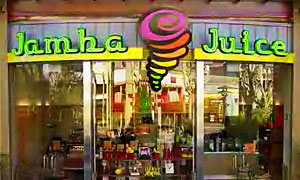
PRODUCT PLACEMENT SHOULD BE A low-risk marketing technique. For the right
price, marketers can imbed their brands in programs to subtly convey a
positive message, or associate them with favorable characters or plot lines.
But when it comes to HBO, the technique can backfire. A brand can end up with
a potentially detrimental portrayal--and it may not be the marketer's fault.
To be sure, if product placement has come to mean intentional (pay-for-play)
positioning of a brand in a show, then what HBO probably deserves is some
other label. The pay-cable network insists that it does not take payola: As an
extension of its commercial-free philosophy, it says it accepts no money in
exchange for brand integration.
So Madison Avenue, according to the network, is not the reason that a Porsche
or Tropicana carton or David Yurman timepiece shows up in "The Sopranos."
Instead, it's Hollywood--specifically, screenwriters who may be looking to
advance the story, make a point tongue-in-cheek, or simply create
verisimilitude.
That last point apparently is the reason that mob boss Tony Soprano gave his
materialistic wife a spanking new $110,000 Porsche SUV in the season premiere.
"Of course, he gave her a Porsche," an HBO spokeswoman said. "Do you think
he's going to give her a Saturn? Don't you think a Porsche is consistent with
that character?"
While the Porsche Cayenne came off looking like a sweet ride in the show--Tony
proudly touted its 4.5-liter V8--the same positive takeaway cannot be said of
smoothie chain Jamba Juice in the April 30 episode (evaluated and ranked via
research firm iTVX as one of the five most effective product placements last
week).
While it may be a legal gray area, it appears as if producers can insert
brands into programs without regard for how they're portrayed. A Jamba Juice
spokeswoman said the company had no knowledge that it would play a role in the
episode.
The problem for Jamba Juice is that "The Sopranos" didn't focus on its Berry
Lime Sublime or Strawberry Surf Rider, or any of its other delicious
concoctions--but instead opened up the hot-button issue of national chains
moving into neighborhoods and displacing long-time down-home merchants.
In the episode, Tony is approached by a real-estate broker representing Jamba
Juice, who wants to buy a building he owns in an old Italian neighborhood that
is starting to undergo gentrification. A coffee chain (surely Starbucks,
though perhaps lucky for the Seattle chain, it wasn't mentioned by name) is
moving in, along with presumably pricey residential high-rises. Barnes &
Noble, Whole Foods, and Best Buy probably aren't far behind.
Jamba Juice would replace Caputo's poultry store in the building Tony owns. At
first, Tony is stunned that funky Jamba would be interested in the ol'
neighborhood with its grocerias, pizzerias, and cannoli-stocked pastry shops.
"Jamba Juice wants to put a store in around here?" he says incredulously.
He has offered $175 a square foot, but resists. An aggressive Jamba Juice then
ups its offer to $225. The broker is so determined, she chases Tony down at
his Bada Bing strip joint with the proposal. Still no deal. Tony says he has
no desire to put Caputo out of business. Finally, Jamba ups the offer to $275.
In a poignant scene, Tony accepts, just after he waves to an old woman who
symbolizes the neighborhood's tradition.
When Caputo gets the news that he's out, he's irate. "God damn juice place
moving in here. Juice! Jamba Juice," he tells two Soprano apparatchiks. "Your
boss went and sold the building."
For Jamba Juice--with its carefully cultivated image as a groovy laid-back,
California-cool kind of place (the company has said "it believes in playing an
active role in the communities where it does business")--"The Sopranos"
portrayal as a company willing to kick a neighborhood business out in pursuit
of profits could not have been welcome. Unlike Wal-Mart, which frequently gets
pilloried when it tries to move into new neighborhoods and threatens local
merchants' business, operations like Jamba and Starbucks usually get a free
pass--partly because of their grassroots aura, and partly because they have a
large bourgeoisie clientele. To be sure, much of the criticism against
Wal-Mart comes from the sheer size of its stores and issues about worker
health insurance and treatment--but don't Jamba and Starbucks grab business
from local diners, coffeehouses, and health food merchants?
The Jamba Juice spokeswoman would not comment on how the company felt about
its depiction in "The Sopranos." She did say that the company is excited that
"we have made a mark in pop culture" with mentions in Us Weekly, a spoof on
"Saturday Night Live," and "The Sopranos."
Given the choice, however, Jamba Juice might have taken a pass on the
appearance as the rapacious, profit-driven out-of-town chain. Better to stay
under the radar as the company continues its aggressive expansion plans. Like
so many characters on "The Sopranos," Jamba learned what can happen when it
interacts with Tony's crew--even as an apparently unwitting victim.