Summary: As if
there isn't enough advertising in grocery stores these days, it looks like even
the black conveyor belt at check-out will be a thing of the past.
Ads to be Printed on Grocery Store Conveyor
Belts
Latest Version of Ad Creep Targets Check-Out Lines
By Mya Frazier
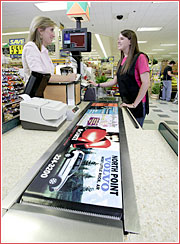 COLUMBUS,
Ohio (AdAge.com, 8/16) -- That plain-black conveyor belt at the grocery checkout
line is the next stop for ad creep.
COLUMBUS,
Ohio (AdAge.com, 8/16) -- That plain-black conveyor belt at the grocery checkout
line is the next stop for ad creep.
Grocery store conveyor belts have become the latest venue for in-store
advertising.
Conveyor belts
"Conveyor belts have never been on anybody's radar screen for marketing," said
Frank Cox, president-CEO of EnVision Marketing Group, a Little Rock, Ark., firm
with a patented system to print digital, photo-quality ads directly on conveyor
belts. "But a store with eight to 10 checkout lanes, well, you're talking about
100 square feet of wasted ad real estate."
Cincinnati-based Kroger Stores is the first national retailer to open checkout
lines to the ads in a test in a few dozen of its stores, mainly in Northwest
Arkansas; Jackson Miss.; and Memphis, Tenn. Harps Food Stores, a 52-store
grocery chain based in Springdale, Ark., is also testing the system in 13
stores.
Local advertisers
The first marketers to sign on aren't national brands, though, and for now
shoppers see hometown ads with photos of local real-estate agents and insurance
brokers, not the logos of Coca-Cola and Hershey.
Mr. Cox, formerly president of CJRW, an independent ad agency based in Little
Rock, said he waited to knock on Corporate America's door until the system,
dubbed Ads-n-Motion, had the kinks worked out. Additionally, the capital
investment is high. Printers capable of printing on conveyor belts cost upward
of $400,000.
Mr. Cox bought the patent for the conveyor belt ads from the inventor, Joe
Molinaro, and launched EnVision in May 2005. With a sales staff of five, Mr. Cox
said he's aiming first for brands in the checkout aisle, such as candy makers
Nestle, Hershey, and Mars; film makers like Kodak and Fuji; and, of course,
soft-drink brands Coca-Cola and Pepsi.
Exclusivity
As part of the sales pitch, Mr. Cox said he's offering national advertisers the
chance to shut out competitors at the cost of $182,800 a year for the entire
55-store footprint, which Mr. Cox claims can deliver 3.3 million impressions a
month.
"If a national advertiser joins us, they get to own the region and as we grow,
they get the first right of refusal," Mr. Cox said. "That's just about $15,000 a
month to shut your competitors out. So if Duracell buys in, Energizer can't."
Kroger has made its own exclusivity requirements, too, especially in the early
stages of the test when local ads dominated. No ads in its stores can be in
categories competitive with Kroger's own products, including bakeries, florists,
butchers and pharmacies.
Waiting to ask Wal-Mart
Mr. Cox said he's waited to ask for space in Wal-Mart stores until ads were
mostly national brands. "We just figured they wouldn't want us selling
mom-and-pop businesses ads inside their stores," he said.
Alltel, the nation's fifth-largest wireless company, based in Little Rock, is
the first major advertiser to buy conveyor ads, though the company said it's
limited in how it can use the medium. "It really only works to raise brand
awareness," said Andrew Moreau, VP-corporate communications. "You can't promote
on it and can only change the message every two weeks. In our business, it's
hypercompetitive in pricing but it's too difficult to get a pricing message on
something like this. It's much easier to change a newspaper or online ad."
Getting 'checked out'
For Huey Couch, advertising manager at Harps Food Stores, which is testing
conveyor ads in 13 stores, the upside is getting a percentage of the gross
advertising sales in addition to having its belts paid for and maintained by
EnVision.
Mr. Couch said he received a few consumer complaints from one store the first
week the ads were installed almost a year ago, but none since. "To the consumer
it is probably not this in-your-face-wow kind of thing," Mr. Couch said. "It's
kind of more subdued to them. They just want to put their items on the belt and
get checked out. If they see it, they may not pay attention, but it's embedded
in the mind a little bit."